
Electric Heating Elements
Tubular Heating Elements
Tubular heating elements are a building block for industrial heating equipment. Geometry, sheath material, power and mounting need to be specified together for the intended duty.
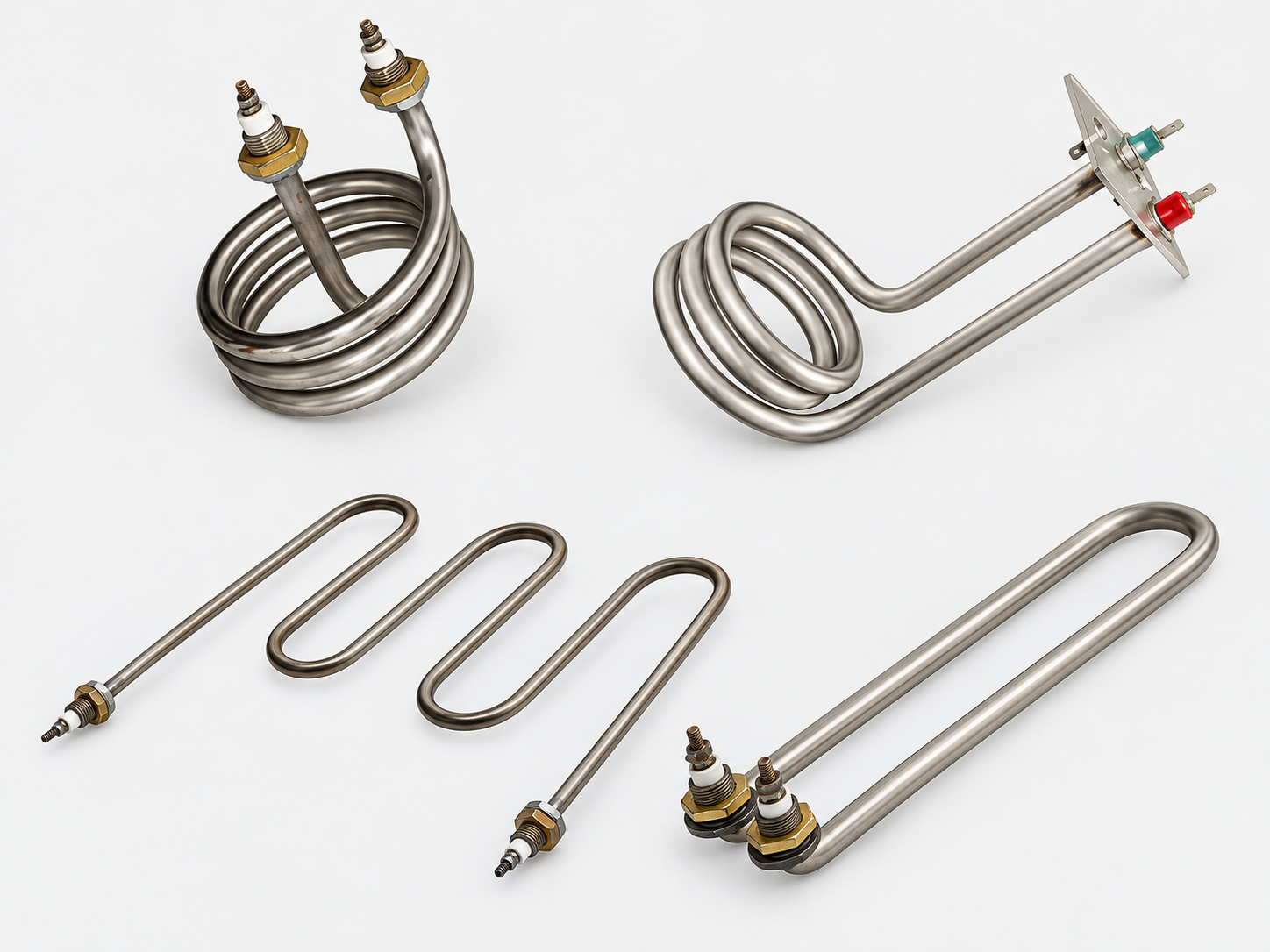
Tubular Heating Elements — Process Flow
Confirm installation/heat transfer → energise elements → transfer heat → regulate power by temperature feedback.
Tubular Heating Elements — Applications
Basic industrial heating components formed to drawing for suitable fluid, air or contact heating.
Tubular Heating Elements — Heating Media
Design separately for gas, immersion or contact heating; medium and heat transfer are key inputs.
- Gases: air, nitrogen and assessed compatible gases; do not repurpose a liquid element for air without review.
- Liquids: water, thermal oils and cleaning/salt solutions assessed for compatibility.
- Contact heating: moulds, plates and cast modules with verified fit and heat transfer.
- Inputs: composition, temperature, ramp and immersion/gas/contact arrangement.
- Heat transfer: liquid velocity, airflow or contact conditions; allowable watt density (W/cm²).
- Environment: moisture, corrosion, vibration and terminal temperature.
Liquid/gas heat transfer differs; allowable load depends on flow, viscosity and temperature. Natural-convection designs also need specific validation; gas service does not mean unprotected dry operation.
Tubular Heating Elements — Technical Specifications
Confirm voltage, power, dimensions, medium and watt density first; final requirements follow drawings and acceptance.
Tubular Heating Elements — Material Selection
Select for medium, sheath temperature, corrosion and watt density; material temperature references are not complete-element ratings.
- 304: assess water, some air duties and compatible cleaners; ≤400°C is not a universal rating, and medium/sheath temperatures differ.
- 321: assess elevated-temperature air; 300–600°C is a duty reference requiring sheath-temperature, oxidation and life review.
- 316L: assess some mild acids/alkalis or chloride media against concentration/temperature; not universally corrosion-resistant.
- Incoloy800: assess high-temperature heating; duties above 600°C require complete design validation and do not permit dry operation of liquid elements.
- Copper: assess suitable water duties against water quality, temperature and sulphur/chloride compatibility.
- Insulation: MgO with controlled dryness, compaction and sealing.
- Seals: silicone, ceramic or other constructions for terminal temperature, moisture and insulation; ceramic alone does not establish waterproof sealing.
Tubular Heating Elements — Customization Options
Assess custom constructions/configurations to equipment drawings; manufacture after confirmation.
- Shapes: straight, U/W, spiral or custom, with confirmed bend radii/dimensions.
- Materials: 304/321/316L/Incoloy800/copper, confirmed for compatibility.
- Mounting: threads, flanges and clamps with specified dimensions.
- Terminations: rods, suitable high-temperature leads, ceramic terminals and lead lengths.
- Sensing: assess integrated K/J thermocouples and locations.
- Finish: suitable polishing or blasting.
- Options: fins for air heat transfer, with temperature, spacing, dust and cleaning review.
Custom dimensions, power, materials and protection follow agreed drawings.
Tubular Heating Elements — Frequently Asked Questions
Grouped by selection, installation and maintenance.
Selection
What selection inputs are required?
Provide voltage, power, material, shape/dimensions, medium, temperature, mounting and termination. Heat transfer and watt density affect life.
Are air and liquid elements interchangeable?
Do not interchange without design review. Watt density, sheath temperature, sealing and protection can differ; liquid elements may overheat without liquid.
What do fins do?
Increase air-side heat-transfer area; match flow, temperature, deposits and cleaning, with protection.
Installation and Commissioning
What matters during installation?
Maintain required immersion for liquid heated zones, designed flow for gas duties and correct fit for contact heaters. Protect terminals from overheating/moisture and provide earth.
How are multiple elements connected?
Qualified electrical personnel must confirm star/delta circuits against element voltage and drawings. On a balanced 380V three-phase supply, star branches see approximately 220V and delta branches 380V; apply only with compatible ratings/design.
Maintenance
What maintenance is needed?
After shutdown, isolation and cooling, remove scale/oil/dust as instructed; check insulation, terminals, level/airflow and protection.
How are leakage or early failures investigated?
Isolate immediately; qualified personnel check low/no flow or liquid, scale, moisture, corrosion, overvoltage and watt density. Do not reuse faulty elements.
Selection information does not replace a site design. Provide suitable temperature, overheating and electrical protection and follow delivered instructions.
Related heating directions
All products ↗START WITH YOUR APPLICATION
A clear requirement.
A better starting point.
You do not need every technical detail to begin. Describe the duty and share what you know.