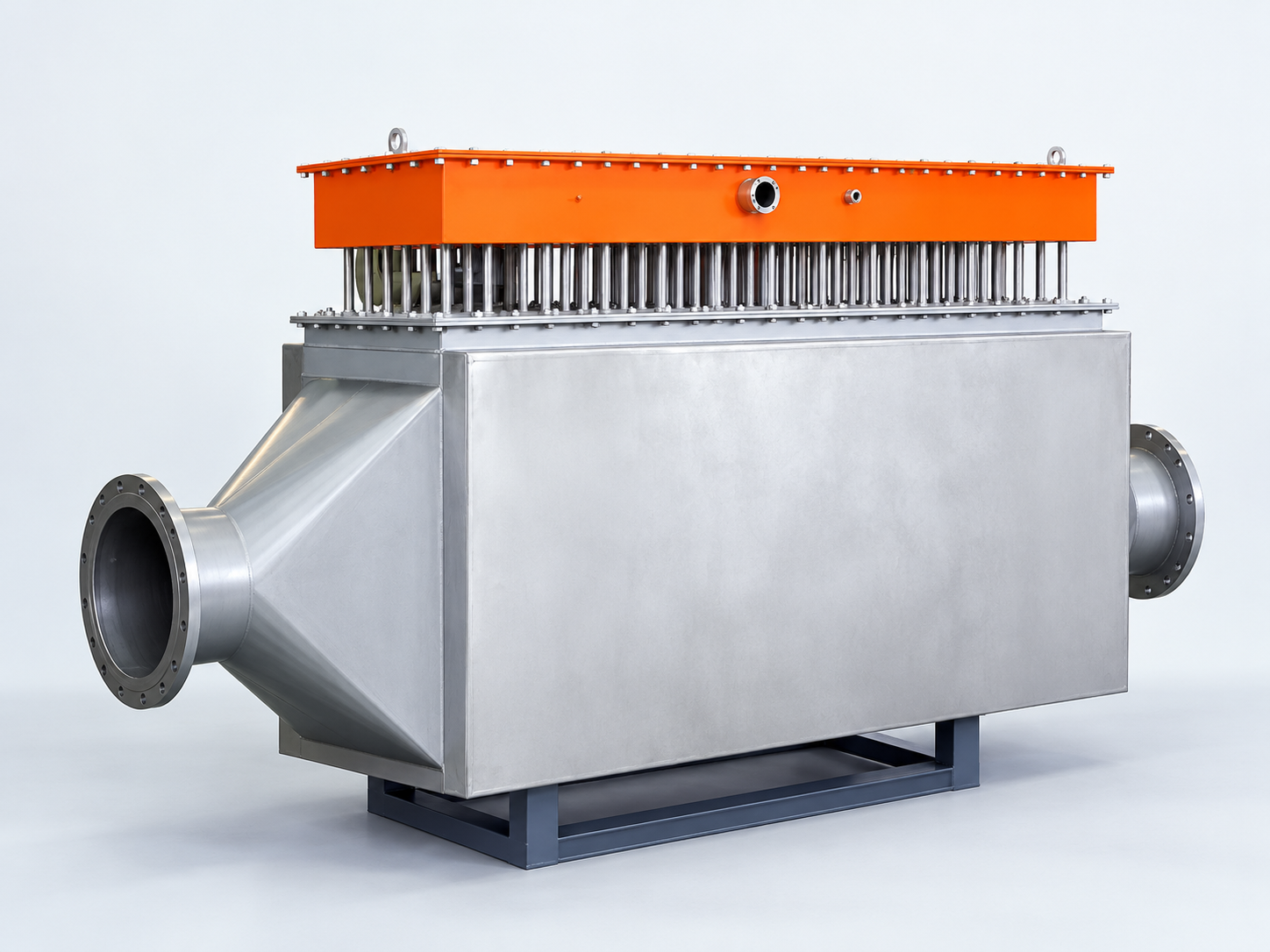
Duct air heaters add heat to moving air in a defined duct section. Airflow, temperature rise and available installation space are essential selection inputs.
Forced-convection duct heating: air absorbs heat from elements in an enclosed duct; outlet sensing feeds PID/PLC or other controls. Start the fan and verify minimum airflow before permitting heating.
Show moreShow less
Pre-Start Checks
Inspect ductwork, heater flanges and vessel welds for air leakage.
Remove debris and dust to prevent deposits and local hot spots.
Verify main dampers, bypass and inspection covers against the startup procedure; ensure covers are sealed.
Check inlet/outlet temperature, pressure, airflow and element surface-temperature instruments.
Check cable insulation, protective earth and phase sequence; verify interlocks.
Set target temperature and approved overtemperature, overload and low-flow protection values.
Check insulation, cooling arrangements and access seals.
Startup Sequence
Start the supply/exhaust fan first and establish stable airflow; heating is prohibited with no or insufficient flow.
Verify flow above the minimum and provide heating permission; a fan-running signal alone is insufficient.
Once heating is permitted, air passes through the elements via the specified flow-distribution arrangement and heats by forced convection.
Deliver heated air to drying, curing, space heating or assessed exhaust-pretreatment duties.
PID adjusts power from outlet temperature; confirm PLC or other control configuration for the project.
Monitor static pressure as designed; blockage or abnormal pressure triggers alarms and protection.
Operating Monitoring
Monitor inlet/outlet temperatures, static pressure, flow and element temperature; adjust power for flow and inlet-temperature changes.
Disconnect heating on low/no flow; continued fan cooling depends on the fault and must not be assumed safe during fan failure or hazardous-atmosphere conditions.
Gas or element overtemperature alarms and disconnects heating; pressure interlocks and relief measures follow duct design.
After shutdown, isolation and cooling, remove dust and oil deposits under the maintenance plan to prevent local overheating.
Normal Shutdown
Disconnect heating first; keep the fan running to remove residual heat where safe.
Stop the fan when temperatures reach the safe range specified in the manual; operate dampers as instructed.
Before cleaning for extended shutdown, confirm electrical isolation, cooling and safe maintenance conditions.
Emergency Shutdown
Leakage, overtemperature, blockage, fan failure or electrical faults trigger heating isolation and alarms. Determine fan operation from the fault and manual; do not restart before resolving the fault and rechecking protection.
Process Flow
Fresh air → fan → duct heater → heated air → process station → exhaust/return duct. Monitor outlet temperature, static pressure, airflow and element temperature; protect with minimum-flow, outlet/element overtemperature and designed pressure/relief measures.
Duct Air Heater — Applications
Assess continuous or intermittent hot-air processes against airflow, temperature rise, composition, dust and hazardous-area requirements.
Show moreShow less
Drying: production-line materials, foods, medicinal herbs, wood veneers, paper, coated parts and grain.
Coating: spray-booth circulation, paint/powder curing and workpiece preheating; assess solvents and combustible dust.
Composites: glass-fibre curing, carbon-fibre thermoforming and insulation-panel curing ovens.
Food/pharmaceuticals: clean air, ingredient drying and packaging drying; stainless steel alone does not establish hygienic suitability.
Rubber/plastics: rubber preheating, pellet drying and extrusion-line circulating-air heating.
Exhaust treatment: RCO/RTO pretreatment, catalytic-oxidation preheating and odour-gas heating, subject to specific safety assessment.
HVAC/buildings: factory heating, cleanroom ventilation preheating and mine-entry freeze protection.
Other industries: mould preheating, feed gases, laboratory hot air and pipeline heating-air supply.
Assess construction, materials and complete hazardous-area suitability for corrosive, dusty or combustible gases.
Duct Air Heater — Heating Media
Air is a common medium; confirm other gases and recirculated air against medium conditions.
Media: air, recirculating hot air, nitrogen or other inert gases; assess traces of dust or mildly corrosive gases.
Temperature: inlet, target outlet and permissible variation.
Properties: dust, humidity, oil mist and corrosive constituents.
Duty: rated airflow, minimum protective flow and design pressure; specify actual or reference conditions.
Hazards: combustible gases, vapours and dust-explosion risks.
Clean dry air is common. Assess filtration, cleaning and fire risks for oil mist/dust. Filtration does not replace hazard assessment; blockage reduces flow, so validate minimum-flow protection.
Duct Air Heater — Technical Specifications
Confirm airflow, temperature rise and heat duty first, then match construction, supply, materials and protection.
Show moreShow less
Selection Checklist
Airflow, Temperature Rise and Heat-Duty Checklist
Category
Details
Airflow and Heat Duty
Rated actual flow (m³/h); state reference conditions for normalised flow; temperature rise (°C); calculated heat duty (kW); minimum protective flow; design pressure
Temperature
Inlet/target outlet temperature, permissible variation and element surface-temperature limit
Duct Construction
Connection dimensions, flange standard, overall size, orientation and space
Atmospheric-duty design: assess forced-convection heating. The document’s 800°C value is a potential special-design target, not a verified product rating. Pressure-equipment applicability depends on actual pressure, construction and local requirements.
PID control: validate response and accuracy against flow, thermal inertia, sensing and controls.
Flow distribution: appropriate arrangements improve heat transfer and reduce hot spots; uniformity is not guaranteed for every installation.
Protection: confirm minimum-flow, element-temperature and outlet-overtemperature interlocks to reduce, not eliminate, risk.
Modular integration: review the supply scope for heater, sensing and PLC control panel.
Materials: select vessel and sheath for temperature, corrosion, humidity and dust.
Interfaces: verify duct standard, dimensions and loads rather than assume universal compatibility.
Communication: operating, fault, temperature and pressure signals may be provided to PLC/DCS.
Core Functions
Gas heating: continuously heat flowing air or compatible inert gases.
Temperature measurement and control: configure multiple sensing points and adjust output to maintain the target.
Flow interlock: monitor flow or a validated airflow signal and disconnect heating below the protective threshold.
Overtemperature protection: alarm and disconnect the heating circuit as designed.
Pressure monitoring: abnormal static-pressure alarms/interlocks; confirm relief devices through system design.
Status: operating, fault and alarm feedback to central controls.
Distribution: specified flow plates support uniform element heat transfer.
Final ratings and supplied functions follow the technical agreement, drawings and acceptance.
Duct Air Heater — Material Selection
Select vessel, elements, flanges and auxiliaries for maximum temperature, corrosion, dust, pressure and continuous duty.
Vessel Materials
Q235B carbon steel: reference option for dry clean air; confirm design temperature and construction.
304 stainless steel: verify compatibility for humid, clean and mildly corrosive duties.
316L stainless steel: assess some chlorine-containing/corrosive duties; high-temperature humid corrosion resistance is not universal.
Elements and Auxiliary Parts
304 stainless-steel finned elements: assess lower-temperature air service and verify fin/sheath temperatures and cleaning needs.
321 stainless-steel finned elements: confirm material condition, surface temperature and life for elevated-temperature duties.
Incoloy800 elements: assess high-temperature gas heating; validate continuous-duty limits for the complete construction.
Match flanges, nozzles, flow plates, seals, thermowells and supports to main materials and temperature/pressure conditions.
Duct Air Heater — Customization Options
Review modular configurations for site space, process and safety requirements.
Mechanical: dimensions, inlet/outlet directions, flange standards and mounting base.
Temperature control: single/multiple sensing points, control panel and local/remote operation; RS485 communication or 4–20mA analogue signals as specified.
Protection: overtemperature, flow or validated differential-pressure interlocks, leakage-current and overload protection, audible/visual alarms.
Insulation: suitable ceramic-fibre or mineral-wool materials and stainless-steel cladding.
Electrical: supply-voltage options; assess hazardous-area equipment, instruments, connections and surface temperatures together rather than the control cabinet alone.
Additional arrangements: inspection/cleaning access, baffles, flow distribution and filters.
Surface treatment: blasting, painting or polishing of suitable parts.
Additional functions: observation ports, differential-pressure sensing and bypass arrangements as designed.
Feasibility and supply scope follow confirmed technical documents.
Duct Air Heater — Frequently Asked Questions
Grouped by selection, installation/commissioning and maintenance.
Selection
What information is needed for selection?
Provide actual airflow, inlet/outlet temperatures, gas type, pressure, space, supply and corrosive constituents. Airflow is a key input: together with temperature rise it determines heat duty and influences construction, pressure drop and protection. State reference conditions for normalised flow.
What is the maximum outlet temperature?
The document’s below-300°C finned-element and 800°C high-temperature-alloy figures are preliminary targets, not ratings determined by material alone. Assess flow, power, sheath/vessel temperature, insulation, connections and protection, and confirm through design and acceptance.
Does airflow variation affect operation?
At constant power, lower airflow increases temperature rise and overheating risk. Use an appropriate flow or validated differential-pressure interlock to disconnect heating below the safe threshold.
Installation and Operation
What are the duct and installation requirements?
Provide straight ducting, required straight lengths, supports, access and seals as drawn; lengths/orientation follow airflow design. Remove debris and test the fan, airflow and interlocks with heating disabled before commissioning.
Is an airflow switch required?
Provide a designed and validated minimum-flow heating permissive and protection. Suitable airflow switches, flow measurement or validated differential-pressure signals may be used as specified. Fan-running status alone is insufficient.
Maintenance
What routine maintenance is needed?
After shutdown, isolation and cooling, remove dust/oil; inspect/replace filters, check temperature/pressure/flow sensing, insulation, flanges and welds. Set intervals from the manual, environment and applicable requirements; shorten cleaning intervals in dusty service.
How is slow outlet heating investigated?
Take safe measures under the manual. Qualified personnel should check actual versus design flow, filter blockage, element faults, leakage, supply and PID settings. Seek technical support and do not bypass protection.
This page supports selection, not site procedures or operating instructions. Follow applicable local safety requirements for installation, operation and maintenance.