
Industrial Electric Heaters
Flanged Immersion Heaters
A flanged immersion heater places heating elements in direct contact with the process medium through a flanged connection. The vessel geometry, immersion conditions and maintenance access influence the design.
Process flow
Flanged Immersion Heater — Process Flow
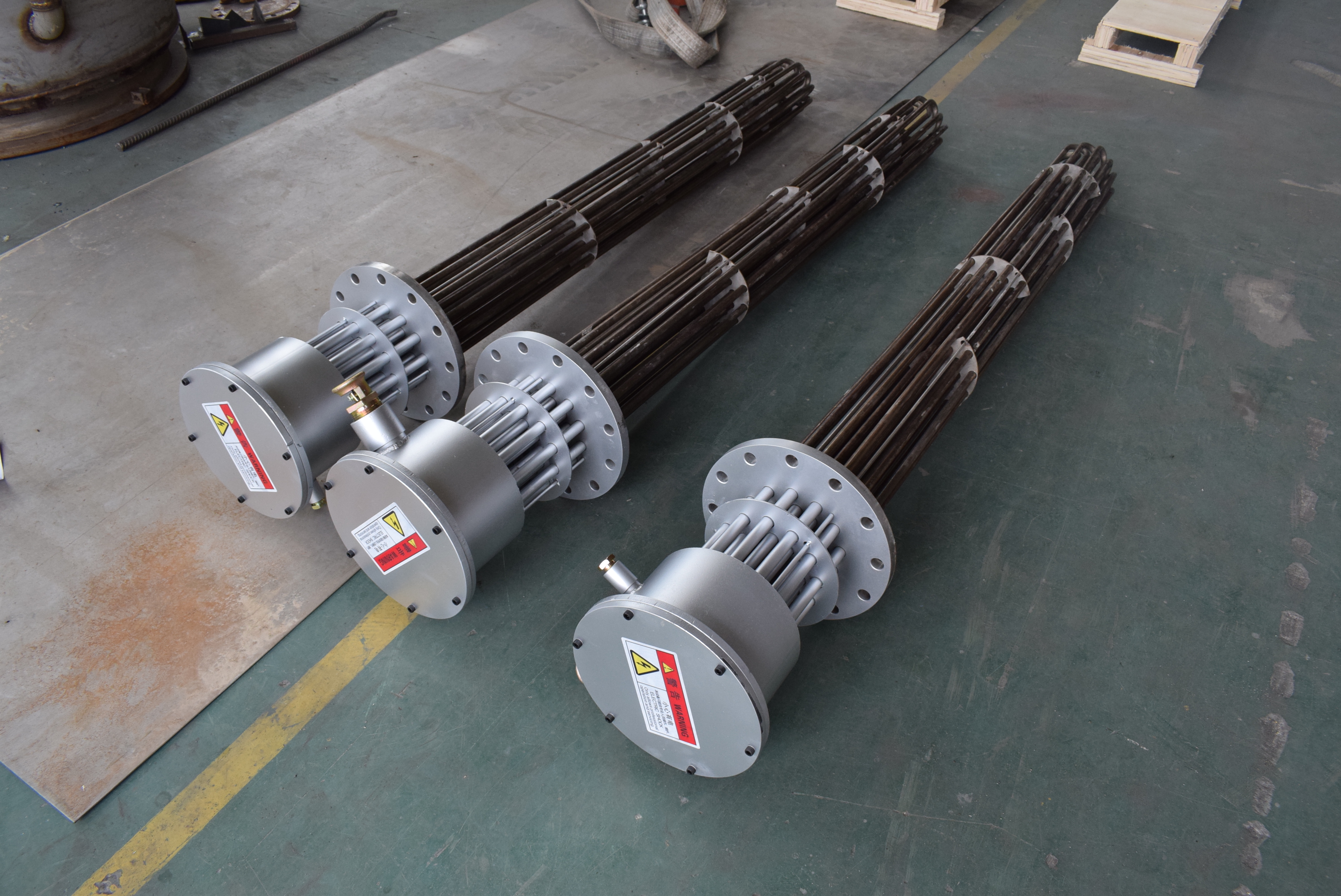
Construction: U-shaped tubular heating elements, flange, temperature-sensor thermowell and terminal enclosure. Main sequence: manufacture individual elements, bend and arrange them, connect them to the flange, seal, electrically test, assemble and dispatch.
Applications
Flanged Immersion Heater — Applications
Flanged immersion heaters use a sealed flange connection, with heating elements immersed directly in the medium for heat transfer. Designs can be assessed for atmospheric or pressurised vessels and explosion-protection requirements, supporting fluid heating, temperature maintenance and freeze protection across industries.
Flanged Immersion Heater — Heating Media
A flanged immersion heater seals to the vessel wall through a flange, with heating elements immersed directly in the medium. Select sheath material and watt density according to the medium.
| Category | Typical media | Selection considerations |
|---|---|---|
| Water | Softened, purified and deionised water | Review 304/316L or other suitable sheaths; control scaling and local overheating through water quality and surface loading |
| Heat-transfer oils | Thermal oil, heat-transfer oil, hydraulic oil, lubricating oil | Control watt density to reduce coking; review Incoloy800 or other suitable materials |
| Hydrocarbons | Crude oil, heavy oil, residual oil, bitumen, wax | Review preheating and flow conditions to reduce viscosity for pumping |
| Chemical liquids | Acids, alkalis, electrolytes, process baths | Assess titanium, suitable alloys or PTFE coatings against composition, concentration and temperature; no universal corrosion-resistant material is assumed |
| Antifreeze media | Ethylene glycol solutions, antifreeze | Freeze protection for pipelines and tanks; confirm liquid level and protection against heating without liquid |
| High-temperature storage | Molten salts | Special high-temperature elements; assess salt composition, corrosion and solidification conditions |
| Gases (limited applications) | Nitrogen, air, process gases | Design for gas-specific heat transfer; control surface loading and provide flow and overtemperature protection |
Before changing the medium in an existing heater, review corrosivity, operating temperature and flash point to avoid incompatible materials or watt density.
Flanged Immersion Heater — Technical Specifications
The following are selection references. Actual supply scope and acceptance criteria must follow confirmed engineering drawings, the technical agreement and applicable standards.
| Item | Range or selection reference |
|---|---|
| Rated voltage | 220V / 380V / 415V / 480V / 660V; review customization against the available supply |
| Rated power | Designed for the process duty; solutions from kW scale to several hundred kW may be reviewed |
| Flange size | DN25–DN500 is a reference range; confirm vessel flange standard, temperature and pressure |
| Sheath material | 304 / 316L / Incoloy800 / titanium / PTFE coating or other compatible options |
| Watt density | Water ≤2.5W/cm² and thermal oil ≤1.5W/cm² are examples; calculate for the medium and heat-transfer conditions |
| Cold insulation resistance | ≥1000MΩ is a reference value; confirm test voltage, environment and acceptance limit against applicable standards and agreement |
| Dielectric withstand | 2000V for 1 minute without breakdown is an example; determine voltage and duration from rated voltage and applicable standards |
| Ingress protection | IP54 / IP65 or other ratings, confirmed against the actual enclosure |
| Explosion protection | Confirm hazardous-area classification, gas/dust group, temperature class and certification requirements; Ex d IIC T1–T6 is not one universal rating |
| Temperature sensing | Type K/J thermocouple or Pt100 resistance temperature detector, selected for range and measurement point |
| Temperature-control accuracy | ±1°C may be specified as a target; verify against the control system, measurement point and operating conditions |
Electrical performance, dimensions and specified sealing/pressure tests may be inspected and recorded under the inspection plan. Material, ingress-protection and explosion-protection conformity require supporting evidence and acceptance documents, rather than an energisation test alone. Report scope follows the supply agreement.
Flanged Immersion Heater — Material Selection
Sheath material is a key factor in corrosion resistance and service life. The table provides preliminary selection guidance.
| Material | Reference media | Properties and limitations |
|---|---|---|
| 304 stainless steel | Softened water and compatible neutral liquids | Cost-effective; assess corrosion risks in chloride-containing and high-temperature service |
| 316L stainless steel | Purified water, some mildly acidic/alkaline or low-chloride environments | Usually offers better pitting resistance than 304; still verify composition, concentration and temperature |
| Incoloy800 alloy | Compatible thermal oils, high-temperature oils and some chemical media | Suitable for assessed high-temperature duties; confirm corrosion compatibility and retain dry-heating protection |
| Titanium (such as TA2; confirm the actual grade) | Some seawater and corrosive media | Corrosion resistance depends on conditions; TA2 and TC4 are not interchangeable or universally resistant to strong acids and alkalis |
| PTFE / Teflon coating | Compatible corrosive or scaling media | Limited by temperature, surface loading and coating integrity; confirm manufacturing and operating conditions |
Selection principles: consider medium temperature, corrosive species, coking risk and food-contact requirements together. Food suitability is not established solely by 316L or polishing; materials, seals, cleanliness and hygienic design must also be confirmed. Provide medium composition for special-duty assessment.
Flanged Immersion Heater — Customization Options
Customization may be reviewed against engineering requirements, including:
- Power and voltage: determine from the medium, heating duty and electrical supply
- Flange dimensions and holes: match an existing vessel flange or a new opening design
- Element layout and heated/unheated lengths: determine from vessel dimensions and liquid level
- Sheath material: select for medium corrosivity
- Sensing and control: thermocouples/RTDs, multiple measurement points and termination locations
- Terminal enclosure: general-purpose or explosion-protected, confirmed for environment and certification requirements
- Installation: bolted flange connection or specifically engineered welded installation; confirm separately how individual elements connect to the flange
- Surface treatment: pickling/passivation, hygienic polishing or painting of suitable parts
- Inspection and documents: third-party inspection, material certificates, test reports and required certification documents; confirm scope and availability separately
Before customization, provide medium and temperature, vessel dimensions, installation opening, electrical supply and hazardous-area requirements for selection and drawing discussions.
Flanged Immersion Heater — Frequently Asked Questions
Can the heater be used with highly corrosive media?
First assess composition, concentration and temperature, then select titanium, compatible alloys or coatings. Titanium or PTFE coating alone does not establish suitability for every strong acid, alkali or seawater application.
What needs special attention with thermal oil?
Control watt density and heat-transfer conditions to reduce local coking, and provide suitable temperature, level or flow protection to prevent dry heating.
Is a flange connection or welded installation better?
A vessel flange usually permits removal of the complete heater for maintenance; welded installation requires vessel-design assessment. Individual element replacement depends on the element-to-flange construction, not simply on the heater having a flange.
Why distinguish general-purpose and explosion-protected enclosures?
Hazardous locations require equipment matching area classification and certification requirements, installed accordingly. Assess the enclosure, instruments, electrical connections and exposed surface temperatures together; changing the enclosure alone does not establish system compliance.
What affects service life?
Medium corrosivity, watt density, heat-transfer conditions, dry heating and water scaling are major factors. Appropriate materials and protection can help extend service life.
What inspections take place before dispatch?
The inspection plan defines insulation resistance, dielectric withstand, resistance/power checks, specified leak/hydrostatic tests, and visual/dimensional inspection. Explosion-protected products follow the relevant certification and inspection requirements. Individual-unit checks, sampling and report scope follow the technical agreement.
Related heating directions
All products ↗Tubular Heating Elements
For integration into application-specific heating assemblies.
Explore product ↗START WITH YOUR APPLICATION
A clear requirement.
A better starting point.
You do not need every technical detail to begin. Describe the duty and share what you know.