
Industrial Electric Heaters
Thermal Oil Heaters
Electric thermal oil heaters supply heat to a thermal-fluid circuit. Fluid properties, circulation conditions and allowable temperatures must be established before specifying the heater.
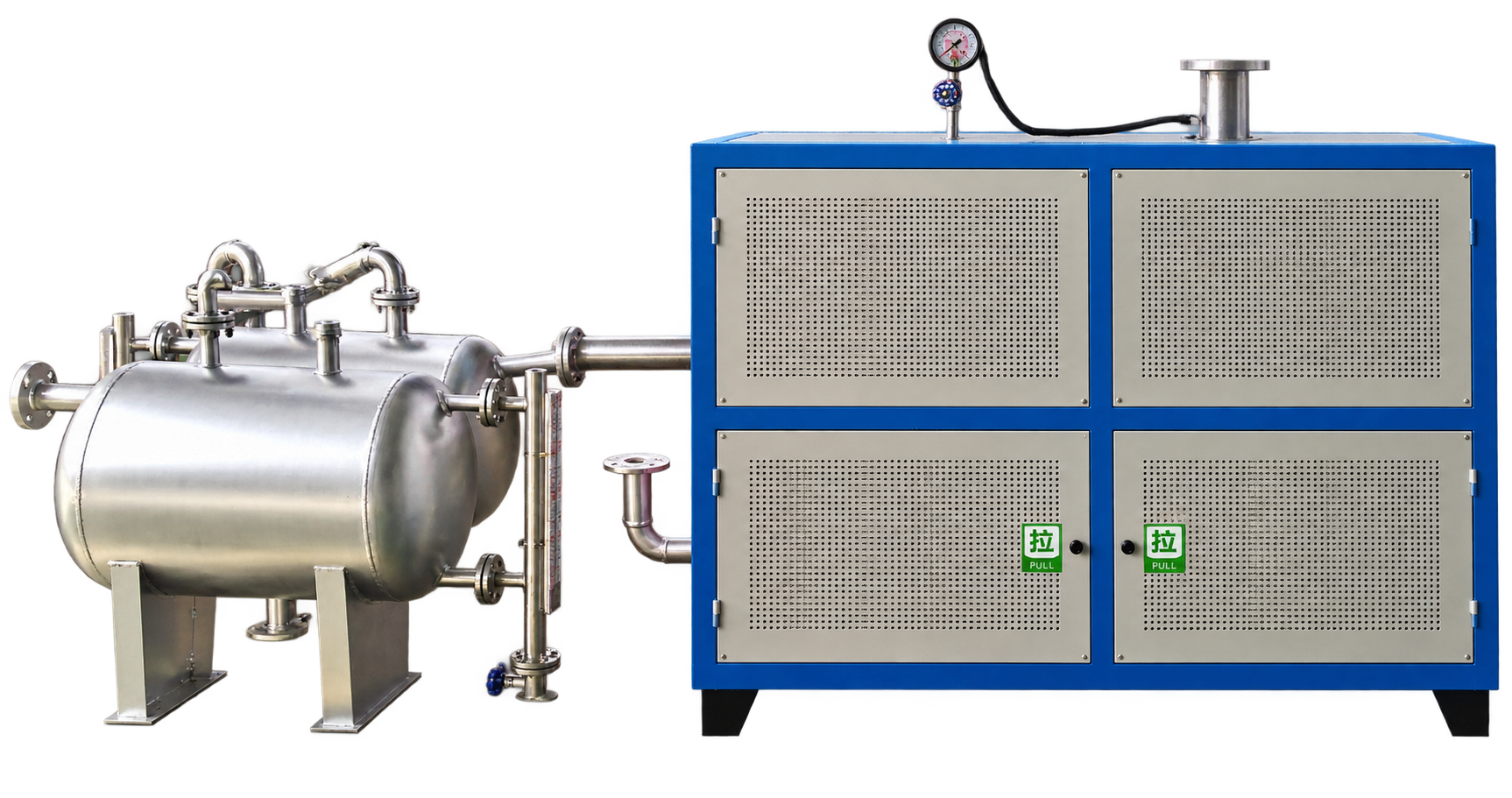
Thermal Oil Heater — Process Flow
A closed forced-circulation loop transfers heat through thermal oil: electric heating → heat delivery to process equipment → return for reheating, providing continuous heat under designed conditions.
Thermal Oil Heater — Applications
Assess industrial heating, drying, temperature-maintenance and tracing duties against heat load, supply temperature, oil grade and hazardous-area conditions; control accuracy or steam replacement is not universally guaranteed.
Thermal Oil Heater — Heating Media
Thermal oil (organic heat-transfer fluid) is the liquid-phase medium in the standard concept; the specific fluid is a core design input.
- Grade and type: mineral or synthetic thermal oil.
- Temperature: maximum permitted bulk and film temperatures, supply/return temperatures.
- Properties: viscosity, flash point, acid number, carbon residue and thermal stability.
- Operating conditions: circulation flow, velocity and design pressure.
- Contaminants: water, light ends and solids.
- Risks: flammability, high-temperature oxidation and ageing.
Compare mineral and synthetic fluids using product-specific data. Maintain designed minimum flow/velocity and control film temperature to limit coking. Specify expansion volume and oxidation control such as nitrogen blanketing through system design.
Thermal Oil Heater — Technical Specifications
First provide heat duty, circulation and minimum protective flows, and supply/return temperatures; assess the design against permitted oil bulk and film temperatures.
Thermal Oil Heater — Material Selection
Match the vessel, elements and auxiliary parts to oil temperature, chemistry, pressure, continuous-duty requirements and budget.
- Vessel: assess pressure-vessel steels such as Q245R/Q355R; verify pressure capability against standards, temperature, thickness, welding and inspection.
- Stainless vessels: assess 304/316L against oil composition, temperature and corrosion; acid or chloride content alone does not establish suitability.
- Element sheaths: select 304, 321, Incoloy800 or other materials against sheath temperature, loading, compatibility and continuous service; heat resistance does not permit dry operation.
- Match flanges, nozzles, gaskets, thermowells and filters to main materials and temperature/pressure conditions.
Thermal Oil Heater — Customization Options
Review modular skid designs against process, installation space and safety requirements.
- Mechanical: vessel dimensions, nozzle orientation, flange standards and skid frame.
- System integration: circulation pump, expansion/storage tanks, vents, filter and sampling point.
- Controls: multiple sensing points, PLC cabinet, local touchscreen, 4–20mA or RS485 interfaces.
- Safety: flow, high/low pressure, level and sheath-temperature protection with audible/visual alarms.
- Explosion protection: assess the complete equipment, cabinet, instruments, connections and surface temperatures against area classification and certification requirements.
- Insulation: suitable ceramic-fibre or other insulation with galvanised or stainless cladding.
- Surface treatment: blasting, suitable corrosion-protection paint and stainless-steel finishing.
- Additional options: sampling/drain connections and a bypass cooling module.
All customization follows the mutually confirmed technical documents.
Thermal Oil Heater — Frequently Asked Questions
Grouped by selection, installation/commissioning and maintenance for preliminary discussion.
Selection
What are the key selection inputs?
Provide heat duty, supply/return temperatures, oil grade, pressure, circulation flow, space, supply and hazardous-area conditions. Heat duty and flow influence power, construction and protection thresholds.
What is the maximum temperature?
It depends on the specific oil bulk/film limits, materials and design. Mineral-oil 280°C and synthetic-oil 320–350°C figures are examples for some products, not universal limits; avoid continuous operation at the permitted limit.
What are the risks of insufficient flow?
Low flow can cause film/sheath overheating, coking, reduced heat transfer, element damage and oil degradation. Provide a suitable minimum-flow interlock.
Installation and Commissioning
What are the installation and piping requirements?
Follow drawings for slopes, vents, supports and expansion-tank arrangement to reduce vessel stress. Pressure-test, clean, purge and remove moisture under approved procedures; follow oil/equipment instructions for dehydration, degassing and heating.
Is an expansion tank required?
Provide expansion volume and pressure-stabilisation measures matched to the design. An expansion tank accommodates thermal expansion; air exclusion depends on sealing, nitrogen blanketing or other arrangements and is not automatic.
Maintenance
What routine maintenance is needed?
Monitor oil properties such as acid number, carbon residue and viscosity; clean filters, calibrate instruments and inspect insulation/leaks under the maintenance plan. Follow instructions for intervals, storage and oil replacement criteria. Shut down, isolate and cool before maintenance.
How should slow heating be investigated?
Qualified personnel should safely check flow, filters, oil condition, element power, load and insulation, obtaining technical support if needed. Do not bypass protection.
This supports preliminary assessment rather than replacing a site-specific design. Follow delivered instructions and applicable thermal-fluid safety requirements.
Related heating directions
All products ↗Custom Heating Solutions
For thermal requirements that need a coordinated scope.
Explore product ↗START WITH YOUR APPLICATION
A clear requirement.
A better starting point.
You do not need every technical detail to begin. Describe the duty and share what you know.